
For a new boutique, choosing a supplier is not a price comparison. It is a risk decision. A dress that looks perfect in a photograph but arrives stiff, thinly lined or late for a birthday or wedding has already cost you more than the price difference between two suppliers.
If you are looking for a wholesale girls dress supplier for new boutiques, use a vetting process before you commit startup capital. Check the build, check the total landed cost, and run a small trial before you scale.
TutuPetti is a Vietnam-based manufacturer and wholesale supplier founded in 2009, specialising in princess, birthday, party, flower girl dresses and tulle gowns for girls. Through its wholesale online shop at tutupetti.net, boutique buyers in the USA, Australia, UK and Europe can explore approximately 127 dress products and inquire about suitable ordering options.
Quick answer: wholesale girls dress supplier for new boutiques
How to vet a wholesale girls dress supplier for new boutiques: check tulle softness, linings, embellishments, seams and closures in detail; calculate landed cost including preparation, shipping and buyer-paid duties, not just the product price; run a low-risk trial order with an arrival checklist; ask direct questions about preparation windows, delivery, photo rights and damaged garments; and compare suppliers on a scorecard, not on price alone. TutuPetti usually needs 3–5 business days for preparation and 4–10 business days for international shipping, and import duties are excluded and paid by the buyer. MOQ, tier pricing, sample fees and size-chart numbers are confirmed on inquiry.
In this guide: 1. Material and construction vetting | 2. Landed cost and logistics | 3. Low-risk trial protocol | 4. Vetting questions | 5. Supplier comparison scorecard | Vetting checklist | FAQs
| Vetting area | What good looks like | Red flag |
|---|---|---|
| Materials | Soft tulle, comfortable lining, secure details | Stiff or scratchy tulle, thin or missing lining |
| Construction | Even stitching, strong closures, finished edges | Weak zippers, loose embellishments, exposed seams |
| Logistics | Clear preparation and shipping windows | Vague timelines, hidden duties or fees |
| Communication | Direct, specific answers | Slow, evasive or generic replies |
| Trial | A trial you can inspect and learn from | Pressure to commit deep before any trial |
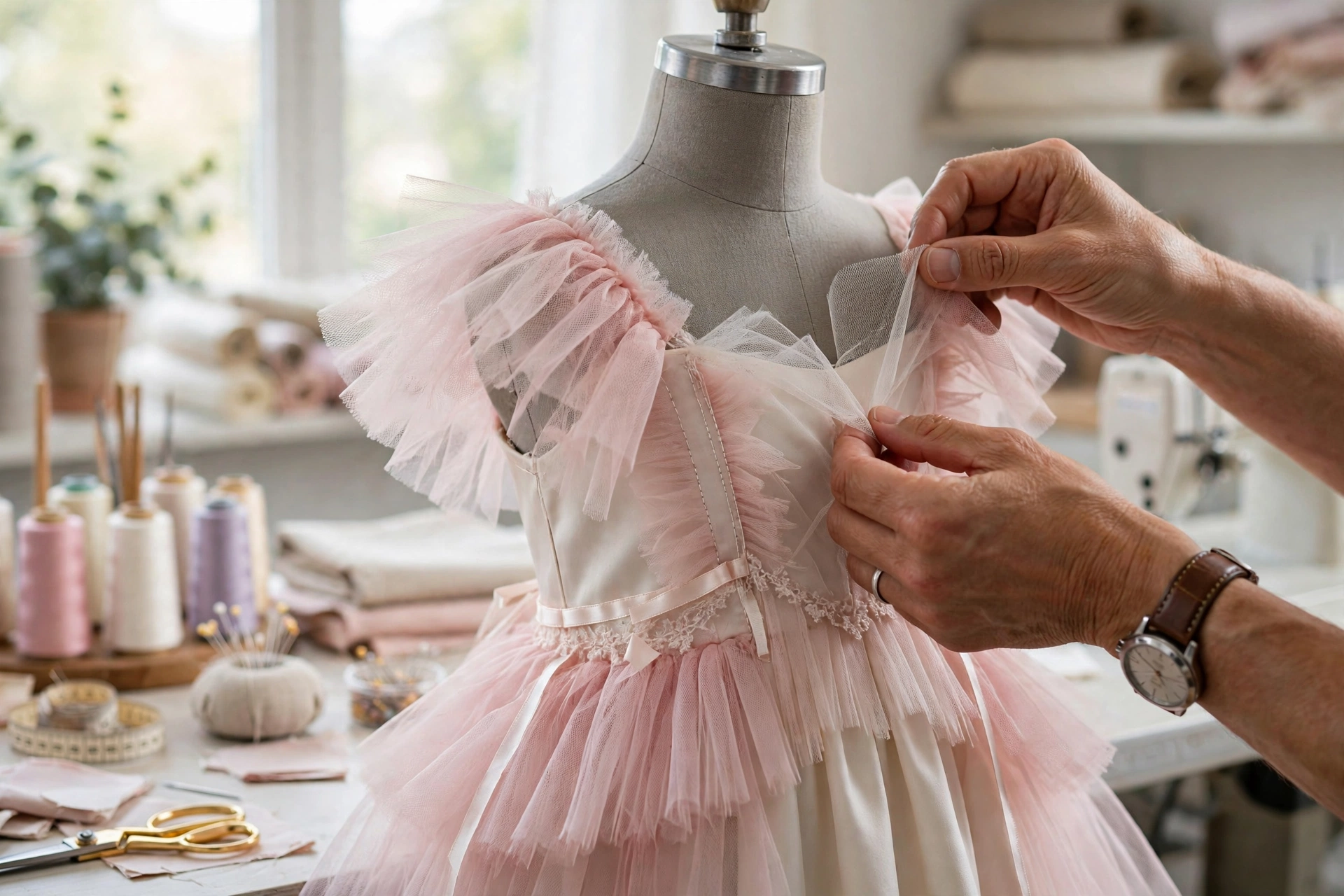
1. Vet material and construction integrity, not just photographs
Generic advice says “check fabric quality.” For children’s occasionwear, that is not specific enough. A structured tulle or party gown has several failure points that photographs hide.
Check these in particular, on a sample or trial dress where possible:
- Tulle softness and skin comfort. Is the tulle soft against the skin, or stiff and scratchy? A dress worn for a whole celebration must not irritate the wearer. Ask about linings, and check whether lace or embellishments sit directly against skin.
- Linings. Are linings present, comfortable and neatly finished, or thin, missing or roughly sewn? A missing lining changes both comfort and how the dress holds its shape.
- Embellishments. Are three-dimensional florals, pearls and other details securely attached, or fragile and likely to loosen? Check attachment points, not only the front view.
- Closures and structured bodices. Do zippers run smoothly on a structured bodice, and do seams hold under gentle tension? Weak closures are a common reason for returns on formal children’s dresses.
- Seams and finishing. Look for even stitching, secure seams and neatly finished edges around the neckline, waist, armholes and hem.
A supplier who answers these questions specifically, with construction details rather than generic reassurance, is already passing an important vetting test. A supplier who avoids them is giving you information too.
2. Calculate landed cost and cross-border logistics honestly
Many wholesale guides are written for domestic buying. A new boutique buying from Vietnam must calculate a different total.
TutuPetti’s usual order preparation time is 3–5 business days, followed by usually 4–10 business days for international shipping. That gives a general planning window of around 7–15 business days before customs delays — an estimate for planning, not a guaranteed delivery date. For fixed-date events such as birthdays, weddings and flower girl duties, lateness can cancel the sale entirely, so plan backwards from the event date and confirm the latest shipping estimate before ordering.
Landed cost is not the product price alone. Ask, for your specific order:
| Cost element | Who pays / what to confirm |
|---|---|
| Product price | Confirmed in your quotation |
| Preparation | Usually 3–5 business days for TutuPetti |
| International shipping | Usually 4–10 business days for TutuPetti |
| Import duties | Excluded from TutuPetti prices, paid by the buyer |
| VAT, GST or handling charges | May apply depending on destination; confirm before ordering |
| Total landed cost | Product price + shipping + duties and charges for your market |
Do not use a tariff rate, HS code or duty formula from a generic guide as your own cost. Duty treatment depends on your country and shipment details. Confirm it for your market before you commit capital.
3. Run a low-risk trial order with an arrival checklist
“Order a sample” is common advice. It is incomplete without a protocol. A trial should test the whole pipeline — processing, fulfilment speed, packaging, photo accuracy and total order-to-door time — not only whether one dress looks nice.
Use this arrival checklist on your trial:
- Photo accuracy. Does the dress match the catalogue photographs in colour, silhouette, layers and details?
- Fabric feel. Is the tulle soft, is the lining comfortable, and do embellishments feel secure?
- Construction. Check seams, closures, edges and attachment points as described in Section 1.
- Packaging. Was the dress protected in transit, and does it arrive in a condition you can present in store after normal finishing?
- Timeline. Did preparation and shipping fall within the windows you were given, and were you updated if anything changed?
- Total cost. Did the final charges match the quotation, or did hidden duties, taxes or carrier fees appear?

Then make a clear decision: proceed, clarify, or pause. Proceed if quality, timeline and total cost all match what was promised. Clarify if one area is unclear but fixable. Pause if the dress differs materially from photographs, if timelines were missed without notice, or if hidden fees appeared. A pause at trial stage is far cheaper than a pause after a deep first order.
4. Ask direct vetting questions before you buy
Generic questions about payment terms and MOQ are a start, but they miss the risks that matter most for event-driven children’s apparel. Ask these directly, and judge suppliers by how specifically they answer:
- What is the usual preparation window, and what happens if it slips?
- What is the usual international shipping window to my country, and who updates me during transit?
- Are import duties included or excluded, and who pays VAT, GST or handling charges?
- What are the fabric, lining and construction specifications for this design?
- Can I use supplier photographs for my shop and social channels, and under what terms?
- What happens if a garment arrives damaged or differs materially from photographs?
- Can I order a sample or trial before a larger order, and what are the sample price, shipping cost and any fee-deduction terms? For TutuPetti, these are confirmed on inquiry.
- How do I confirm the size chart for each design, rather than relying on age labels alone?
- How are reorders handled if a style sells through mid-season?
- Who is my contact, and how quickly should I expect a reply during preparation?
Slow, evasive or copy-paste answers to these questions are themselves a vetting result. Responsive, specific answers are a trust signal.
5. Compare suppliers side by side, not on price alone
“Compare suppliers” is easy advice and hard practice when every supplier presents different tiers, timelines and terms. When choosing a wholesale girls dress supplier for new boutiques, use a simple scorecard and score each supplier yourself on the same criteria. The numbers below are your own 1–5 ratings, not supplier figures.
| Criterion | Supplier A (your score 1–5) | Supplier B (your score 1–5) | Notes |
|---|---|---|---|
| Material and construction quality | Tulle, lining, details, closures | ||
| Preparation and shipping clarity | Windows, updates, event-date reliability | ||
| Landed cost transparency | Duties, VAT/GST, handling, total cost | ||
| Communication clarity and speed | Specific answers, not generic replies | ||
| Trial availability and terms | Sample/trial, price, fee deduction | ||
| Size-chart clarity | Measurements per design | ||
| Reorder and stock reliability | Mid-season reorder, consistency |

TutuPetti’s column is intentionally left for you to complete from your own trial and direct answers, not pre-scored in this article. Price matters, but a lower product price with unclear timelines, hidden duties or weak construction is not a lower landed cost, and it is not a lower-risk choice for a new boutique.
Supplier vetting checklist for new boutiques
- Materials: tulle softness, lining comfort, secure embellishments, strong closures
- Construction: even stitching, finished edges, seams around neckline, waist, armholes and hem
- Landed cost: product price + shipping + buyer-paid duties and charges for your market
- Timeline: preparation 3–5 business days + shipping 4–10 business days, plus customs time
- Trial: arrival checklist completed, photo accuracy, packaging and total cost checked
- Questions: preparation, delivery, duties, photo rights, damaged garments, samples, size charts
- Comparison: scorecard completed on the same criteria for each supplier
- Decision: proceed, clarify or pause — decided at trial stage, not after a deep order
- Quotation: designs, quantities, size breakdown, pricing and MOQ confirmed on inquiry
Frequently asked questions
How do I choose a wholesale girls dress supplier as a new boutique?
Vet construction, landed cost, trial terms and communication on the same criteria for each supplier, rather than choosing on product price alone. Run a small trial and inspect it against an arrival checklist before committing deep.
What should I check on a tulle dress sample?
Check tulle softness against the skin, whether linings are present and comfortable, whether embellishments are securely attached, whether zippers run smoothly on structured bodices, and whether seams and edges are neatly finished.
How long does wholesale delivery from Vietnam take?
TutuPetti usually needs 3–5 business days for preparation and 4–10 business days for international shipping, around 7–15 business days before customs delays. Actual arrival times can vary, and customs clearance may add time.
Do new boutiques pay import duties on wholesale dresses from Vietnam?
Yes. Import duties are excluded from TutuPetti’s prices and are paid by the buyer. Additional VAT, GST or handling charges may apply depending on destination. Confirm them for your market before ordering.
Should I order a sample before a bulk order?
A trial order is the lowest-risk way to test quality, packaging, timeline and total cost. Ask about sample availability, price, shipping cost and any fee deduction, all confirmed on inquiry for TutuPetti.
What is a good trial-order checklist?
Photo accuracy, fabric feel, construction, packaging, timeline against the promised windows, and total cost against the quotation. Decide to proceed, clarify or pause based on that checklist.
What questions should I ask a dress supplier before buying?
Ask about preparation and shipping windows, duty responsibility, fabric and lining specifications, photo usage rights, damaged-garment procedures, sample terms, size charts per design, and reorder handling.
How do I compare two dress suppliers fairly?
Use the same scorecard for both: quality, turnaround clarity, landed-cost transparency, communication, trial terms, size-chart clarity and reorder reliability. Score them yourself from direct answers and trial results.
What are TutuPetti’s wholesale tiers?
TutuPetti names its tiers Start Up, Scale Up and Glow Up. Thresholds, pricing and benefits are confirmed on inquiry for your specific order.
Can boutiques in the USA, Australia, UK and Europe order from TutuPetti?
Yes. TutuPetti serves international wholesale buyers in these markets. Provide your delivery country when requesting a quotation so shipping and order details can be confirmed.
Vet first, then commit
For wholesale girls dress supplier for new boutiques, the cheapest-looking choice is rarely the lowest-risk choice. The supplier who passes material checks, gives clear timelines, explains landed cost honestly, answers direct questions specifically and survives a small trial is the supplier worth scaling with.
TutuPetti, a Vietnam-based manufacturer founded in 2009, offers princess, birthday, party, flower girl dresses and tulle gowns for boutiques building a girls’ occasionwear range. Browse designs in the TutuPetti shop, then contact the team via the About page with your shop details and delivery country, and ask the vetting questions in this guide before your first stock order. Wholesale contact details listed there include the Zalo wholesale contact 0902 506 539 and email tutupetti@gmail.com as published on that page.
