
“Factory direct” is one of the most used — and least defined — phrases in wholesale. Almost every seller claims it, including traders who have never cut a dress. For a boutique, the phrase only matters if it changes something operational: who makes the dress, who answers for quality, who controls the specification, and what the true cost is.
This guide explains how to buy wholesale girls dresses direct from Vietnam factory in practical terms: what direct actually means, how to verify a real factory, what you gain and give up versus an intermediary, how quality control and recourse work across continents, and how to calculate true cost. It invents no factory-direct savings figure, middleman markup, MOQ, discount, price or payment term, because none of those figures has been verified for publication. Where a detail matters, it is written as confirmed on inquiry.
TutuPetti is a Vietnam-based manufacturer and wholesale supplier founded in 2009, specialising in princess, birthday, party, flower girl dresses and tulle gowns. Its wholesale online shop at https://tutupetti.net/shop/ lists approximately 127 products for boutiques in the USA, Australia, UK and Europe.
Quick answer: buy wholesale girls dresses direct from Vietnam factory
Buy wholesale girls dresses direct from Vietnam factory by first verifying that the seller is the maker, not a trader: ask for production evidence, a verifiable physical location, and direct answers about preparation, shipping and duties that only the maker can give consistently. Then weigh the trade-off honestly — direct buying can offer more control over specification and quality, but it also means more operational work for the boutique, including communication, inspection and customs handling. TutuPetti usually needs 3–5 business days for preparation and 4–10 business days for international shipping, around 7–15 business days before customs delays; import duties are excluded from wholesale prices and paid by the buyer. MOQ, tier terms, sample fees, prices, payment terms and defect or return procedures are confirmed on inquiry for your specific order, not assumed from the phrase “factory direct.”
In this guide: 1. What direct means | 2. Verification protocol | 3. Direct vs intermediary | 4. QC and recourse | 5. True cost | Direct-buying checklist | FAQs
| Direct-buying question | What counts as an answer | What does not count |
|---|---|---|
| Who makes the dress? | Production evidence and a verifiable location | A “factory” claim on a landing page |
| What changes operationally? | Direct specification, QC and communication control | A lower price claim with no terms |
| What is the true cost? | Product + shipping + buyer-paid duties + confirmed charges | A piece price alone |
| What if something is wrong? | A confirmed defect and recourse procedure | A generic “quality guaranteed” claim |
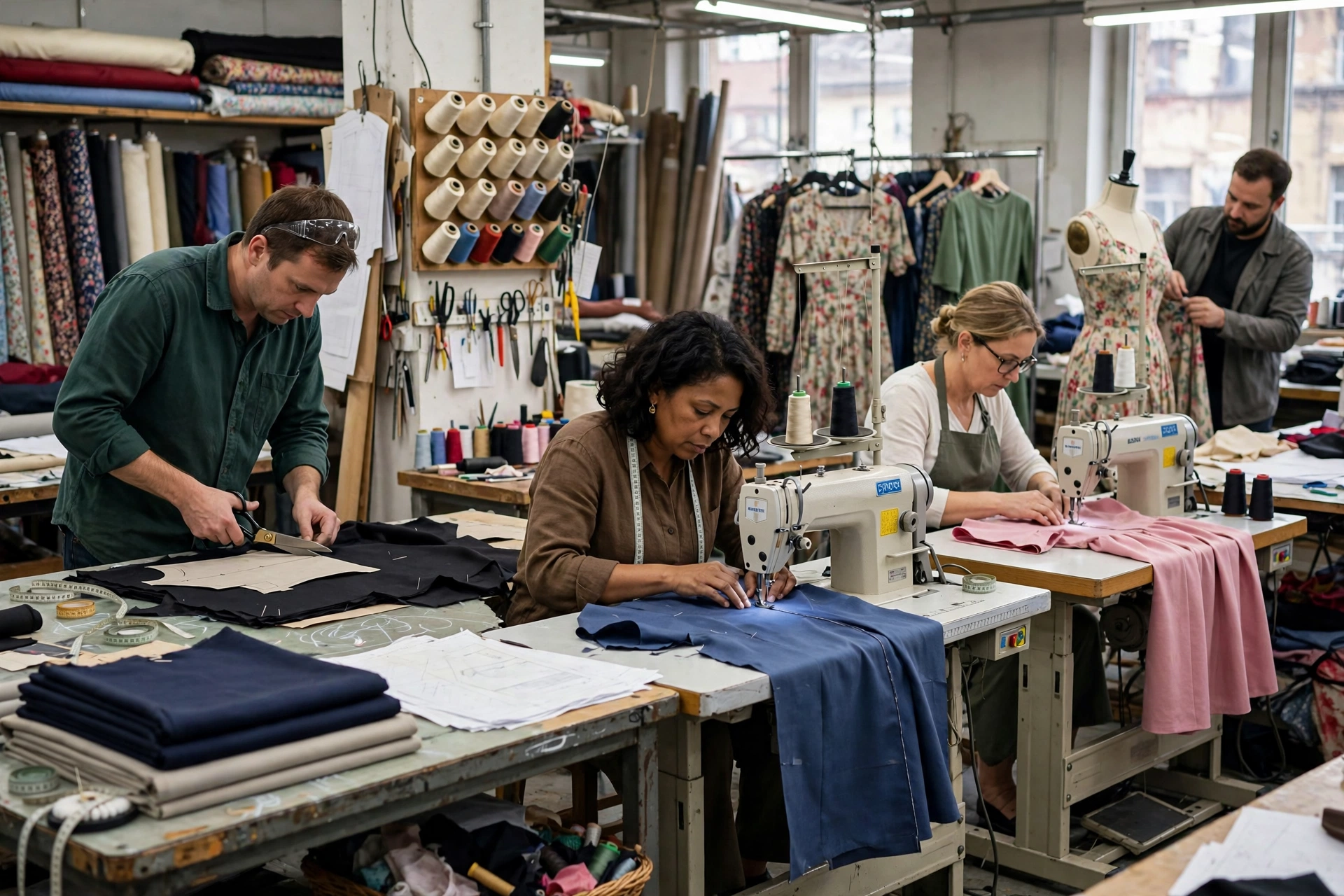
1. What “direct factory” actually means — and what it changes
A direct factory relationship means the boutique deals with the maker of the dress, not with a trading company, agent or dropshipper that resells someone else’s production. That distinction changes four things operationally:
- Specification control. The boutique’s questions about fabric, tulle layers, lining, embellishments and measurements go to the people who cut and sew the dress, not through a reseller who must relay them.
- Quality visibility. Production evidence — cutting, sewing and finishing work — can be shown directly, rather than described second-hand.
- Communication speed and accuracy. Fewer intermediaries means fewer chances for a measurement, colour or quantity detail to be lost in relay, although language and time-zone care is still needed.
- Accountability. When a batch differs from an approved sample, the boutique knows who made it and can pursue the confirmed recourse procedure with the maker directly.
What direct does NOT automatically mean: a guaranteed lower price, a guaranteed lower MOQ, guaranteed customisation, or guaranteed faster shipping. Those terms depend on the specific factory and order, and must be confirmed on inquiry. A seller that uses “factory direct” as a marketing phrase but cannot show production evidence, a verifiable location, or consistent answers about preparation, shipping and duties has not demonstrated directness at all.
2. Verification protocol: how to spot a middleman posing as a factory
Vague advice — “ask for a licence” — does not verify a factory. Use a practical audit checklist, and treat evasive or inconsistent answers as a finding, not as a delay:
- Production evidence. Ask for behind-the-scenes production evidence: cutting, sewing and finishing work on the actual dress types you intend to buy. Stock photographs of dresses are not production evidence.
- Verifiable physical location. Ask for a physical address and location information that can be checked independently. TutuPetti’s public About page lists a store address in Ho Chi Minh City; verify any factory’s location claim against its own published information, not against a directory listing alone.
- Consistent operational answers. Ask the same operational questions — preparation time, shipping time, duty responsibility, MOQ and sample terms — and check that the answers are consistent and specific. A trader relaying answers often gives vague, changing or contradictory terms.
- Direct communication test. Ask a detailed specification question — for example, about tulle layers, lining or a specific embellishment — and judge whether the answer comes from production knowledge or from a catalogue description.
- History and range coherence. Check that the seller’s history, product range and production claims cohere. TutuPetti, for example, is positioned as founded in 2009 with a focused range of princess, birthday, party, flower girl dresses and tulle gowns, approximately 127 products — a coherent specialist range, not an everything-to-everyone catalogue.
No single check proves directness. A pattern of production evidence, verifiable location, consistent operational answers and production-level detail does. If a seller cannot provide that pattern, treat the “factory” claim as unverified, whatever the landing page says.
3. Direct vs intermediary: a balanced trade-off matrix
Direct buying is not purely advantageous. It trades convenience for control, and the right choice depends on the boutique’s capacity. Use this matrix honestly:
| Factor | Direct from factory | Through an intermediary |
|---|---|---|
| Control over specification | Higher — direct to the maker | Lower — relayed through a reseller |
| Quality visibility | Higher — production evidence possible | Lower — described second-hand |
| Operational workload | Higher — boutique handles communication, inspection, customs | Lower — intermediary absorbs some work |
| Convenience | Lower — boutique manages more steps | Higher — one point of contact, often local |
| Risk if something is wrong | Direct recourse with the maker, if confirmed | Recourse through the intermediary’s terms |
| Cost picture | Piece price plus shipping and buyer-paid duties, confirmed per order | Intermediary margin included, but some work absorbed |
A boutique with strong operational capacity — clear specifications, inspection discipline and customs familiarity — may benefit most from direct control. A boutique that needs local stockholding, local returns handling or a single local contact may rationally prefer an intermediary, even at a different cost structure. Neither choice is wrong. The wrong choice is assuming direct is always cheaper, or that an intermediary always adds only cost and no value.

4. Communication, quality control and recourse across continents
Buying direct across continents works only if communication, QC and recourse are defined before the order, not discovered after a problem.
Communication. Agree the working language, response expectations and time-zone handling for specification questions, order updates and problem reports. Put specifications in writing — styles, colours, sizes, quantities, tulle and lining details, embellishments — with photographs attached, so a measurement or colour detail cannot be lost in a voice message.
Quality control. Agree what will be checked, when, and against what: the approved sample or written specification. For embellished dresses, that means tulle layers, stitching, embellishments, colour, silhouette and finishing, checked during preparation and again on delivery. A generic “quality guaranteed” claim is not a QC procedure; a named checklist tied to an approved sample is.
Recourse. Confirm in writing, before paying, what happens with defects or disputes: how defects are reported, what evidence is needed, what remedies apply, and within what timeframe. Defect and return procedures for a specific wholesale shipment are confirmed on inquiry and are not stated in this article, because none has been verified for publication. A boutique that has not confirmed recourse before payment has not protected itself, however good the sample was.
5. True cost: landed cost beyond the piece price
A piece price is not a cost. For direct factory buying, the true cost is landed cost: product cost plus international shipping plus import duties and charges plus any other confirmed charges, divided by the number of dresses.
TutuPetti usually needs 3–5 business days for preparation and 4–10 business days for international shipping, around 7–15 business days before customs delays. Import duties are excluded from wholesale prices and paid by the buyer; duty rates vary by destination and are not stated here, because none has been verified for publication. Do not use a formal Incoterm label for this arrangement unless it has been confirmed for your specific order — the verified fact is only that duties are excluded and buyer-paid.
| Cost element | Include in landed cost? |
|---|---|
| Product cost | Yes, as confirmed for your specific order |
| International shipping | Yes, as confirmed for your specific order |
| Import duties and charges | Yes — buyer-paid, destination-specific |
| Other confirmed charges | Yes, only charges confirmed in writing |
When you buy wholesale girls dresses direct from Vietnam factory, a direct price that looks lower on a piece-price basis can be higher on a landed-cost basis once shipping and duties are added — especially on smaller orders, where fixed shipping charges weigh more per dress. Compare direct and intermediary options on landed cost per dress for the order sizes you actually place, not on piece price alone.
Direct-buying checklist for boutiques
- Production evidence requested: cutting, sewing and finishing work on your dress types
- Physical location verified against the seller’s own published information
- Operational answers checked for consistency: preparation, shipping, duties, MOQ, samples
- Specification question answered with production-level detail, not catalogue description
- Trade-off assessed: control and visibility versus workload and convenience for your boutique
- Communication, QC checklist and recourse procedure confirmed in writing before payment
- Landed cost calculated: product + shipping + buyer-paid duties + confirmed charges, per dress
- Preparation usually 3–5 business days and shipping usually 4–10 business days planned separately, plus a customs buffer
- Sample or specification approved in writing before bulk commitment

Frequently asked questions
What does buying direct from a Vietnam factory mean?
It means dealing with the maker of the dress, not a trading company, agent or dropshipper. Operationally, it means direct specification control, production visibility, direct communication and direct accountability — not automatically a lower price or lower MOQ.
How can I verify a seller is a real factory?
Ask for production evidence, a verifiable physical location, consistent operational answers on preparation, shipping, duties, MOQ and samples, and a production-level answer to a detailed specification question. Treat a pattern of evidence as verification, not a single claim on a landing page.
Is buying direct always cheaper?
No. Compare options on landed cost per dress — product cost plus international shipping plus buyer-paid import duties plus confirmed charges, divided by the number of dresses. A lower piece price can still be higher on a landed-cost basis, especially on smaller orders.
What are the disadvantages of buying direct?
Higher operational workload: the boutique handles more communication, inspection and customs work itself, and must define QC and recourse procedures before payment. An intermediary absorbs some of that work, at its own cost structure.
What preparation and shipping times apply to TutuPetti?
TutuPetti usually needs 3–5 business days for preparation and 4–10 business days for international shipping, around 7–15 business days before customs delays. Customs clearance and local delivery may add time.
Who pays import duties on direct factory orders from TutuPetti?
Import duties are excluded from wholesale prices and paid by the buyer. Rates vary by destination and are not stated here, because none has been verified for publication.
What MOQ and tier terms apply to direct orders?
MOQ thresholds and tier conditions for Start Up, Scale Up and Glow Up are confirmed on inquiry for your specific order. This article does not state them, because none has been verified for publication.
What if a direct order arrives defective?
Confirm the defect and recourse procedure in writing before paying: how defects are reported, what evidence is needed, what remedies apply, and within what timeframe. Specific defect and return procedures are confirmed on inquiry and are not stated here.
Can I customise dresses when buying direct?
Customisation possibilities, if any, are confirmed on inquiry for your specific design and order. Do not assume customisation from the phrase “factory direct” alone.
How do I start buying direct from TutuPetti?
Browse designs in the TutuPetti shop (https://tutupetti.net/shop/), then contact the team via the About page (https://tutupetti.net/about-us/) with your exact styles, sizes, quantities and delivery country, and request written confirmation of MOQ, pricing, sample, payment, shipping and recourse terms for your specific order.
Direct means verified, not just claimed
To buy wholesale girls dresses direct from Vietnam factory, verify the maker, weigh the trade-off, define QC and recourse before payment, and compare on landed cost. A factory claim that cannot show production evidence, a verifiable location and consistent operational answers has not earned the word “direct,” whatever its landing page says.
TutuPetti, a Vietnam-based manufacturer founded in 2009, offers princess, birthday, party, flower girl dresses and tulle gowns for boutiques that want to deal directly with the maker. Browse designs in the TutuPetti shop (https://tutupetti.net/shop/), then contact the team via the About page (https://tutupetti.net/about-us/) with your exact order details and request written confirmation of the terms that apply to you. Wholesale contact details listed there include the Zalo wholesale contact 0902 506 539 and email tutupetti@gmail.com as published on that page.
