
A small boutique does not need a large first order. It needs a small order that teaches it something: which styles sell, which sizes move, whether quality and timing match the promise, and what the true cost per dress really is.
If you are searching for wholesale girls dresses small minimum order, you are probably trying to protect cash while you test a new supplier. That is a sensible instinct — provided the small order is structured well. A badly structured small order, with one unit of too many styles and sizes, teaches you almost nothing and still costs you shipping and duties.
TutuPetti is a Vietnam-based manufacturer and wholesale supplier founded in 2009, specialising in princess, birthday, party, flower girl dresses and tulle gowns for girls. Through its wholesale online shop at tutupetti.net, boutique buyers in the USA, Australia, UK and Europe can explore approximately 127 dress products and inquire about suitable ordering options. TutuPetti’s specific minimum order figure, if any, is confirmed on inquiry for your proposed order — this article does not state one, because none has been verified for publication.
Quick answer: wholesale girls dresses small minimum order
How to use a wholesale girls dresses small minimum order well: keep the order focused on a few core styles, choose sizes flexibly around core demand rather than accepting rigid pre-packs, calculate landed cost per dress including shipping and buyer-paid duties before you judge margin, and plan your reorder trigger before the trial sells out. TutuPetti usually needs 3–5 business days for preparation and 4–10 business days for international shipping, around 7–15 business days before customs delays. A small order protects cash and limits dead stock, but it usually means higher shipping cost per dress and narrower coverage. MOQ, tier thresholds and pricing are confirmed on inquiry.
In this guide: 1. Landed cost on small shipments | 2. Trial-order ratios | 3. Restock timing | 4. Small vs volume trade-offs | 5. Questions to ask about minimums | Small-order checklist | FAQs
| Small-order decision | Protects you when | Hurts you when |
|---|---|---|
| Few core styles | You learn what sells | You spread one unit across too many styles |
| Flexible size choice | You match real demand | You accept rigid pre-packs with dead sizes |
| Landed-cost maths first | You judge margin honestly | You judge margin on product price alone |
| Reorder trigger planned | Bestsellers can be reordered in time | Bestsellers sell out with no plan |
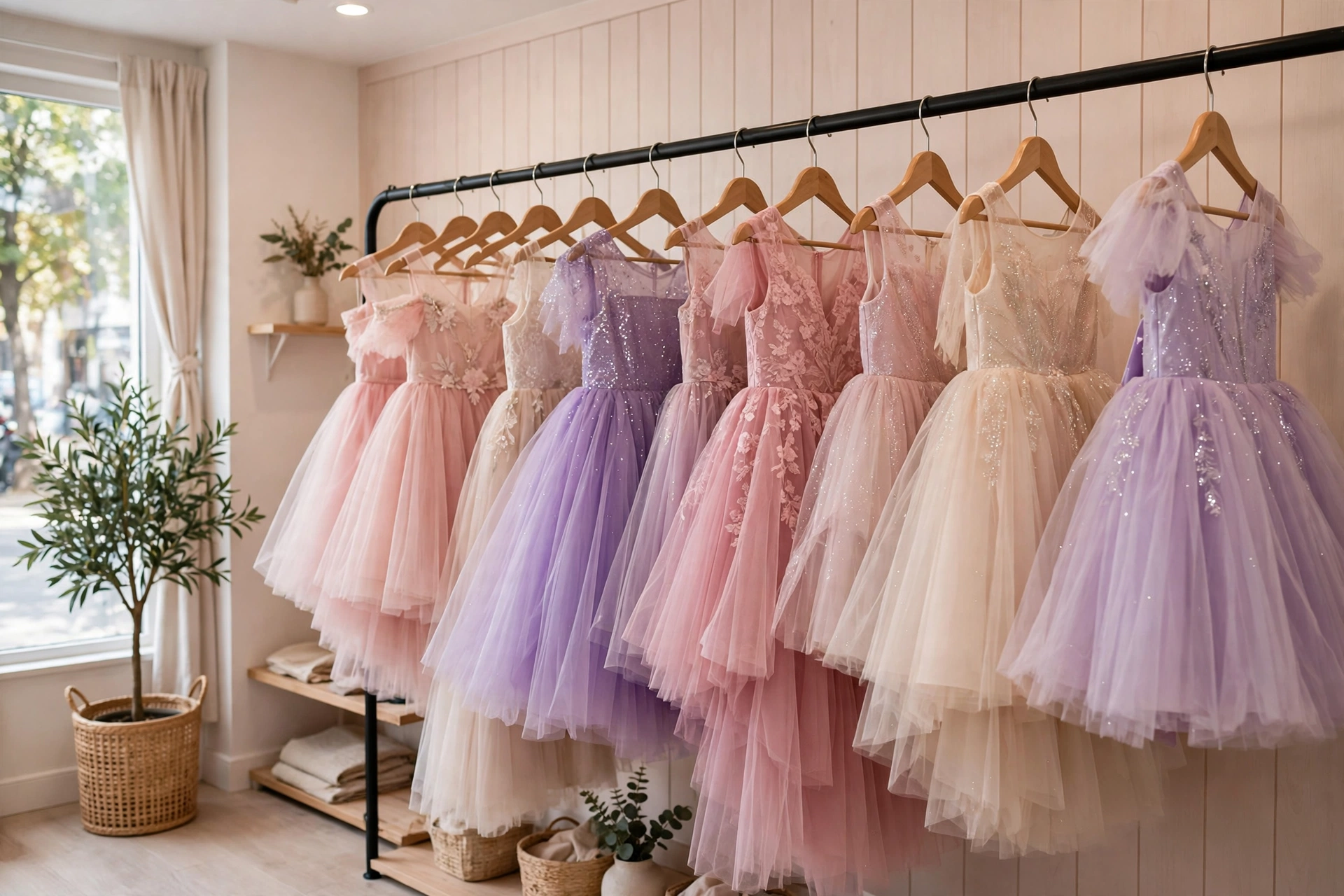
1. Landed cost distorts margins on small shipments — calculate it first
Promotional “low MOQ” headlines rarely show the maths that matters. On a small international shipment, shipping and duties can change the cost per dress far more than a small change in product price.
Use this framework for your specific order, with figures confirmed in your quotation:
Landed cost per dress = (product cost + international shipping + import duties and charges) ÷ number of dresses in the order
Two effects hit small orders hardest:
- Base shipping charges. International courier costs include base charges that do not fall proportionally when you order fewer dresses. The fewer dresses in the parcel, the higher the shipping cost per dress.
- Volumetric weight. Layered tulle and structured princess gowns are bulky. Carriers may charge on volumetric weight rather than actual weight, so a small parcel of bulky dresses can cost more per dress than you expect from product price alone.
Mitigation strategies, in qualitative terms only:
- Focus the order. Fewer styles with sensible depth per style usually ship more efficiently than one unit of many styles, and teach you more about demand.
- Confirm shipping before judging margin. Ask how shipping is calculated for your trial order, including volumetric treatment, before you decide whether the order works financially.
- Budget duties separately. Import duties are excluded from TutuPetti’s prices and paid by the buyer. Additional VAT, GST or handling charges may apply depending on destination. Do not use a generic tariff rate as your cost; confirm treatment for your market.
A small order is not automatically cheap per dress. It is cheap in total cash at risk. Judge it on landed cost per dress, not on product price alone.

2. Balance breadth and depth in a small trial order
A small order faces a tension: breadth tells you what sells, depth lets you actually sell it. Too much breadth — one unit of many styles and sizes — leaves you with a rail of single pieces that cannot serve a party set and cannot prove demand. Too much depth in one untested style risks dead stock.
Use these ratio principles:
- Start with a few core occasionwear types. Princess, birthday, party and flower girl styles that suit your customers’ real occasions, rather than every seasonal novelty at once.
- Prefer classic colours for the core. Classic colours are easier to sell across occasions and seasons than a colour tied to a single event, which can become leftover stock if timing slips.
- Choose sizes flexibly where possible. Ask whether sizes can be chosen flexibly rather than as rigid pre-packs, and whether styles and sizes can be mixed to reach a minimum. Flexible selection lets you weight core sizes and keep rare sizes shallow, rather than being forced into dead sizes.
- Keep seasonal styles as a small layer. A seasonal colour or style can test a peak, but it should not dominate a small order. If it misses the peak, it becomes the dead stock you were trying to avoid.
For wholesale girls dresses small minimum order, the goal of a trial is learning with limited risk, not covering every possibility. A focused trial that sells through teaches you more than a scattered trial that sits.
3. Plan restock timing before the trial sells out
A successful small order creates its own problem: the bestseller sells out. Top guides rarely explain what happens next, and boutiques discover restock risk only when a customer asks for a size that is gone.
Plan the reorder trigger before you order:
- Decide what “sell-out” means for you. Is it when a core size sells out, when a style drops to one unit, or when a party enquiry cannot be completed? Define the trigger in advance, not after the fact.
- Align reordering with real timing. TutuPetti usually needs 3–5 business days for preparation and 4–10 business days for international shipping, around 7–15 business days before customs delays. Add a customs and local-delivery buffer for your market. A reorder placed when stock is already gone will arrive after the event it was needed for.
- Ask about continuity. Can the same style be reordered, in the same sizes, after a trial? If a style may be discontinued, that risk should be part of your trial decision, not a surprise after success.
- Keep a shortlist, not a single bet. If one style sells through, having a proven second style ready to reorder or substitute protects the rail while the first is restocked.
Restock planning is part of a small order, not an afterthought. A trial without a reorder plan is only half a test.

4. Small minimums vs volume tiers: the real trade-offs
Small orders and volume tiers are not good versus bad. They are different tools, with different trade-offs, and the right choice depends on what you are trying to learn versus what you are trying to scale.
| Small minimum order | Higher volume tier | |
|---|---|---|
| Cash at risk | Lower total cash, easier to test | Higher total cash, needs proven demand |
| Dead-stock risk | Lower, if focused | Higher, if styles or sizes are untested |
| Shipping cost per dress | Usually higher on very small shipments | Usually lower per dress as volume rises |
| Coverage | Narrower styles and sizes | Broader and deeper, if demand supports it |
| Price position | Entry-level pricing, not volume discounts | Volume pricing may apply, terms confirmed on inquiry |
TutuPetti names its wholesale tiers Start Up, Scale Up and Glow Up. Thresholds, qualifying amounts and discount percentages are confirmed on inquiry for your specific order, not stated in this article. Do not assume that a higher tier automatically means a better deal for a first test: if demand is unproven, the lower cash risk of a small order may be worth more than a lower unit price on stock you cannot sell.
The decision rule is simple: test small and focused first, then scale into volume tiers once styles, sizes and timing are proven by real sales.
5. Ask about minimums precisely — a tactical checklist
“Do you have a low MOQ?” is too vague to get a useful answer. Ask precisely, and record the answers for your specific order:
- Is the minimum counted by unit count, total amount, or per style?
- Can styles, colours and sizes be mixed to reach the minimum?
- Can sizes be chosen flexibly, or must they follow a fixed pre-pack?
- How is shipping calculated for a trial order, including volumetric treatment?
- What are the preparation and shipping windows for this order?
- How are import duties, VAT, GST and handling charges treated at delivery?
- What are the sample or trial terms, including price, shipping and any fee deduction?
- How does reordering work if a trial style sells through?
- What tier would this order fall under, and what terms apply to that tier?
- Who is the contact for follow-up questions during preparation and shipping?
Precise questions protect you twice: they reveal whether a supplier’s minimum fits your boutique, and they reveal whether the supplier answers specifically or hides behind a promotional headline.
Small-order checklist for boutiques
- Focus: a few core styles, classic colours for the core, seasonal styles as a small layer
- Sizes: flexible selection where possible, core sizes weighted, rare sizes shallow
- Landed cost: product + shipping + buyer-paid duties and charges, calculated per dress
- Shipping: volumetric treatment and base charges confirmed before judging margin
- Restock: trigger defined, reorder aligned to 3–5 + 4–10 business days plus customs buffer
- Continuity: same style and sizes reorderable, or discontinuation risk understood
- Trade-offs: small order for learning, volume tier for proven demand, not the reverse
- Questions: unit vs amount vs per-style minimum, mixing, shipping, duties, samples, tiers
- Confirmation: designs, quantities, size breakdown, address and total checked immediately
- MOQ and pricing: confirmed on inquiry for your specific order, not assumed
Frequently asked questions
What is a small minimum order for wholesale girls dresses?
It is a low total order designed to test styles, sizes, quality and timing with limited cash at risk. The specific minimum for TutuPetti is confirmed on inquiry for your proposed order, not published as a fixed figure in this article.
Is a small order cheaper per dress?
Not necessarily. Total cash at risk is lower, but shipping cost per dress is usually higher on very small international shipments, especially for bulky tulle dresses. Judge a small order on landed cost per dress, not product price alone.
How many styles should a small trial order include?
Keep it focused: a few core occasionwear styles that suit your customers’ real occasions, with seasonal styles as a small layer. One unit of many styles teaches little and cannot serve party sets.
Can I choose sizes flexibly instead of a pre-pack?
Ask TutuPetti directly whether sizes can be chosen flexibly and whether styles and sizes can be mixed to reach a minimum. Flexible selection lets you weight core sizes and avoid dead sizes from rigid pre-packs.
How do I calculate landed cost for a small order?
Add product cost, international shipping and import duties and charges, then divide by the number of dresses. Import duties are excluded from TutuPetti’s prices and paid by the buyer. Confirm shipping treatment, including volumetric weight, for your specific order.
What happens if my small trial sells out?
Plan a reorder trigger before you order, and align reordering with preparation usually 3–5 business days plus shipping usually 4–10 business days, plus a customs buffer. Ask whether the same style and sizes can be reordered.
Do small orders get volume discounts?
Volume pricing is tied to tiers, not to small trial orders. TutuPetti names its tiers Start Up, Scale Up and Glow Up, with thresholds and benefits confirmed on inquiry.
How long does a small wholesale order from Vietnam take?
TutuPetti usually needs 3–5 business days for preparation and 4–10 business days for international shipping, around 7–15 business days before customs delays. Customs clearance may add time.
Do I pay import duties on a small order?
Yes. Import duties are excluded from TutuPetti’s prices and are paid by the buyer, regardless of order size. Additional VAT, GST or handling charges may apply depending on destination.
Can boutiques in the USA, Australia, UK and Europe place a small order with TutuPetti?
Yes. TutuPetti serves international wholesale buyers in these markets. Provide your delivery country when requesting a quotation so shipping, duties and order details can be confirmed.
Test small, learn fast, then scale
For wholesale girls dresses small minimum order, the winning strategy is not to order as little as possible. It is to order focused, calculate landed cost honestly, plan the reorder before success creates a stockout, and ask precise questions about minimums before you commit.
TutuPetti, a Vietnam-based manufacturer founded in 2009, offers princess, birthday, party, flower girl dresses and tulle gowns for small boutiques testing a new range. Browse designs in the TutuPetti shop, then contact the team via the About page with your styles, size breakdown and delivery country, and ask the minimum questions in this guide for a specific quote. Wholesale contact details listed there include the Zalo wholesale contact 0902 506 539 and email tutupetti@gmail.com as published on that page.
